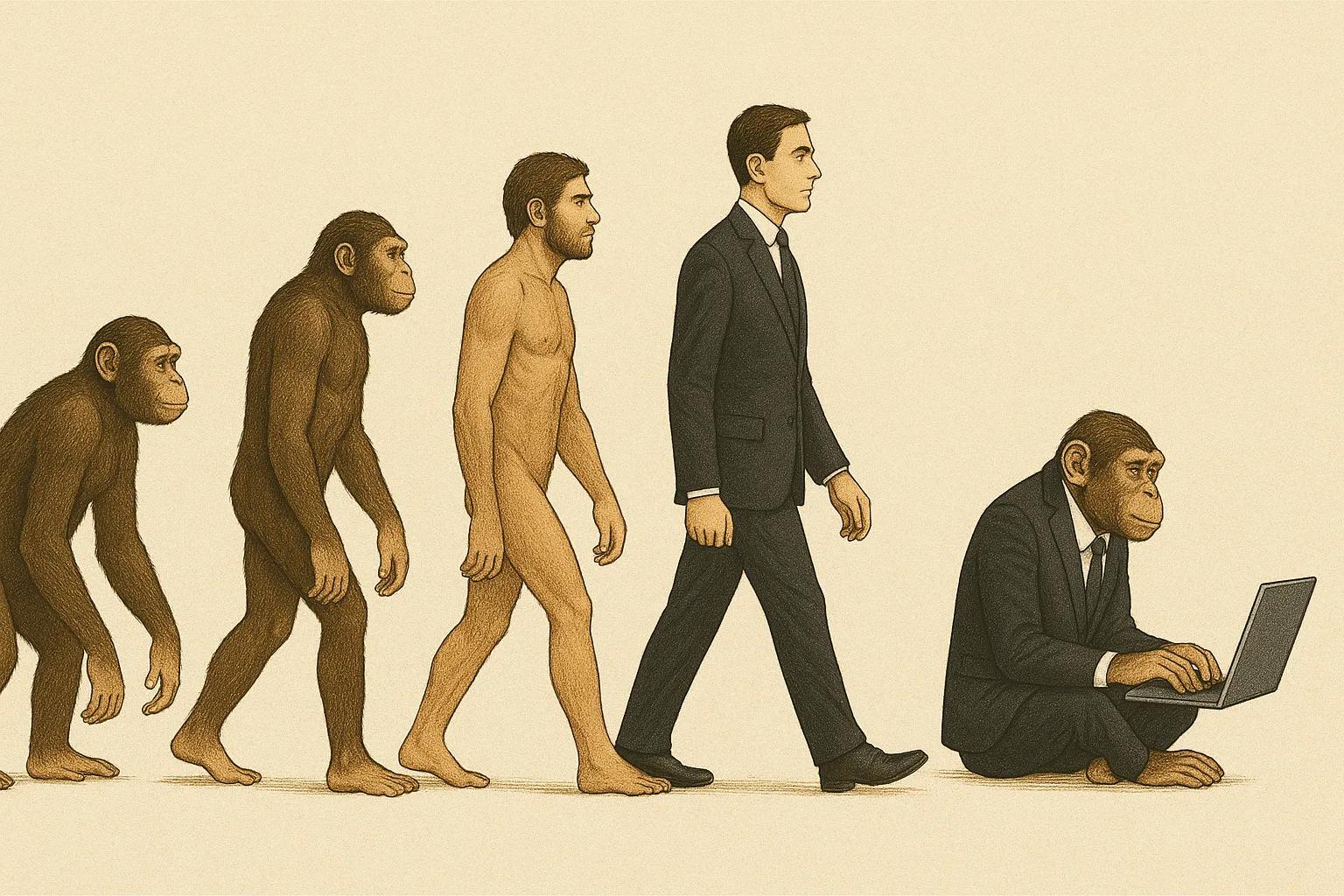
Adapt or die
Why I'm Starting This Blog
At a previous organization, a new senior leader joined and sent an email to the entire company. The content had all the hallmarks of AI generation: excessive em-dashes, the usual syntactical tells ("We're not just a company—we're a movement!"), and worst of all, it was vague and generalized, it didn't tell us anything insightful or new.
It felt lazy and insincere. If he didn't put any effort into writing it, why should I put any effort into reading it? It's a good example of how we can either use AI to do things quickly but badly, or use it to do things better than we could have done alone, and hopefully quickly as well. I want to use AI for brainstorming, fact-checking, and polishing my original ideas. Not just writing at people for the sake of being seen (looking at you, LinkedIn).
In the spirit of showing how the sausage is made, this post explains how I wrote this post. I'll likely use a similar methodology going forward.
LLMs will likely make everyone sound the same. Authenticity will become a differentiator. I'll try to be authentic on this blog.
What I'm Exploring
This blog covers the ground I'm actively working on, organized loosely into a few buckets:
Learning. I'm obsessed with how LLMs change the way we acquire knowledge. Not just consuming information faster, but learning differently. I've been building tools to test this, including Babblo, a language learning app, and I'll share what's working and what isn't.
Coding. I'm not a traditional developer, but I've been using Claude Code to build things I couldn't have built alone, including a personal assistant that automates parts of my workflow. There's a new kind of maker emerging who thinks in systems rather than syntax.
Marketing. What does marketing look like when AI can generate endless content? How do you stand out? Besides looking at digital marketing in this context, this blog is partly an experiment in that question (personal branding as practice).
Operational Improvements. This is where my leadership brain kicks in. I've spent years thinking about how organizations work and why they often don't. Now I'm asking: how can these tools make teams more effective? What does AI-assisted decision-making actually look like in practice?
Innovation. Can LLMs help generate genuinely new ideas, or do they just remix what already exists? I'm curious about applications beyond software, physical products, services, business models. The jury's still out, and I want to explore it.
Why Write in Public?
Partly, yes, to build a profile as someone who understands this space deeply enough to be useful. But there's a more selfish reason: accountability.
It's easy to skim the surface of a dozen AI tools and feel like you're keeping up. Writing forces me to go deeper. If I have to explain something clearly enough for someone else to understand it, I have to actually understand it myself. Public learning is uncomfortable, which is exactly why it works.
And there's a leadership question underneath all of this that I keep coming back to: How can mastering these tools make me better at helping organizations improve? That's the thread connecting everything I'll write about here.
Over the last year, the pace of change in AI, especially with large language models, has crossed a personal threshold for me. This no longer feels like a trend you can observe safely from the sidelines. This is a structural change in how software is built, how work is done, and how leverage is created.
Momentum Wants Somewhere to Go
Publicly sharing what I'm working on creates pressure, in a good way. It forces me to finish thoughts, ship experiments, and move beyond vague intentions.
Right now, most of my momentum is in applied AI: actually using these tools to build things, not just talk about them. One of those projects is Babblo, which I built using Claude Code as a core development partner. Watching an LLM go from "assistant" to something closer to a junior engineer has been one of the most eye-opening work experiences I've had in years.
Writing about this keeps my execution bar high and forces me to explain what I'm really learning, not just what looks impressive on a slide.
This Is Also About Reinvention
I've spent years in senior leadership roles, building and scaling teams, owning delivery, revenue, operations, and results. That experience still matters enormously, but the shape of leadership is changing.
This blog is part of my reinvention, not away from leadership, but toward a new version of it. Adapt or die.
Owning My Public Surface Area
There's another, very practical reason I'm starting this.
More and more, people won't learn about you by reading your CV. They'll ask an LLM who you are. That's already happening.
When someone prompts a system for information about you, your digital footprint becomes the raw material that shapes the answer. I want to be intentional about that surface area. I want it to reflect the reality of how I think, what I build, and how I work, not just a static LinkedIn summary.
Self-publishing has never been easier. LLMs make writing, editing, structuring, and shipping ideas dramatically faster. The cost of putting thoughtful work into the world is effectively approaching zero.
So I'm taking control of that. It's not just a blog, it's a movement! (Joking!)
Let's Connect
If you're exploring any of this too, whether you're experimenting with AI in your own work, leading a team trying to figure out what to adopt, or just curious about where this is all heading, I'd genuinely like to hear from you. Reach out. The best insights usually come from conversation.