KPIs Aren't the Problem. How We Talk About Them Is.
I've sat in more executive and finance reviews than I can count where the conversation goes something like this:
"Margin is down, we need to cut costs."
"Revenue is light, sales needs to sell more."
On the surface, these statements are true. In practice, they're often dangerously incomplete.
They usually stop at what I'd call Layer 2 thinking: revenue and costs. Occasionally Layer 3. Rarely beyond that. And almost never at the level where leaders actually have levers they can pull without unintended consequences.
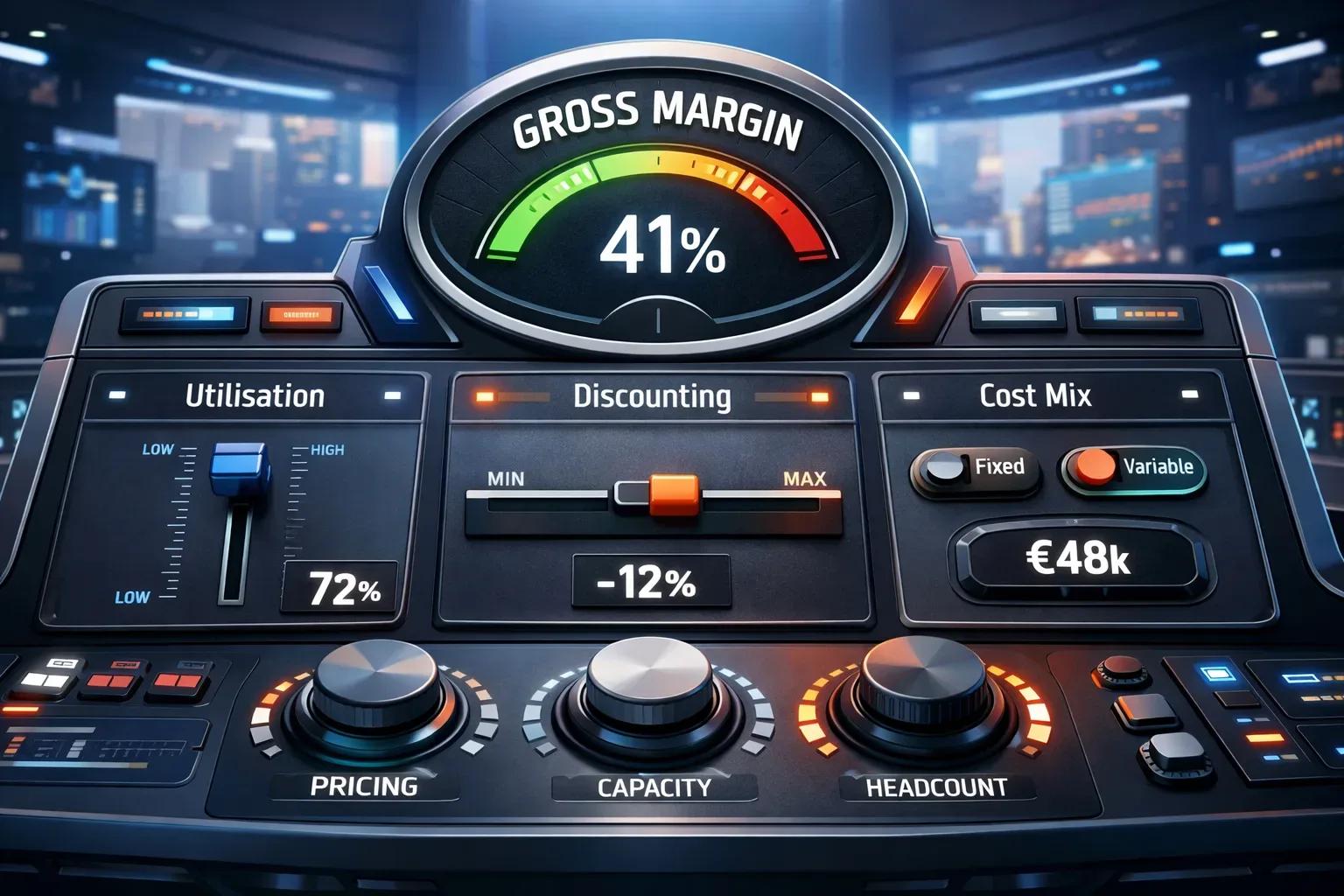
A KPI Driver Tree can overcome that frustration. I've built an interactive one using Claude Code to illustrate how this helps for service delivery KPIs.
From KPIs as Scores to KPIs as Levers
Most dashboards treat KPIs like a scoreboard. Green equals good. Red equals bad. Useful for reporting. Terrible for decision-making.
A KPI Driver Tree flips this idea around.
Instead of asking "What's our margin?" it asks "What is margin made of, and what actually moves it?"
At the top sits Gross Margin. Below it, revenue and costs. Below that, things like billable days, realised rate, utilisation, and fixed vs variable costs.
Crucially, each metric is explicitly connected to the ones above it.
This matters because most leadership arguments aren't about numbers. They're about causality.
Why "Cut Costs" Is Often the Wrong First Move
Here's a real pattern I've seen repeatedly:
- Margin dips
- The instinctive response is to reduce headcount
- Delivery capacity drops
- Billable days fall
- Revenue follows
- Margin doesn't recover
The original diagnosis wasn't wrong. Margin was down. But the intervention ignored how that margin was being generated in the first place.
With a KPI Driver Tree, you can trace a margin dip all the way down to something operational:
- Utilisation slipped due to ramp-up delays
- Discounting increased on renewals
- Scope creep eroded realised rates
Those are very different problems. They deserve very different fixes.
The Power Move: Scenario Testing
One feature I deliberately built into the dashboard is the ability to temporarily override a metric, a "Set % change" control on each block.
This lets you ask better questions:
- What if utilisation improved by 2%?
- What if discounting crept up another 3%?
- What if we cut costs here instead of there?
Instead of debating opinions in a meeting, leaders can see the downstream impact flow through the tree. It turns vague strategy conversations into concrete trade-offs.
KPIs Should Feel Like Controls, Not Post-Mortems
My slightly heretical view is this: if a KPI doesn't map to a lever you can push or pull, it's mostly noise.
Driver Trees don't magically make decisions easy. But they make them explicit, which is the real win.
If you're a services leader who's ever struggled to align finance, sales, and delivery around the same reality, this mental model is worth stealing.
And if you're curious how this might apply to your own organisation, I'm always happy to compare notes.