
AI for job hunting
For most of my career, LinkedIn has been the default interface between me and potential employers. The problem is that platforms like LinkedIn have to cater to the average user. To work at scale, they optimise for the broad middle of the market.
The result is the software equivalent of plain vanilla ice cream: basic and boring. As someone with senior leadership experience, the vast majority of junior and mid-level roles are simply not relevant to me. Yet LinkedIn keeps recommending them anyway. That's the cost of serving the average. Some features are also poorly designed, for example when you set up a job alert, you get one email per alert resulting in a lot of emails with little signal and a lot of noise.
On top of that, they've added features to help with monetisation that distract from their original purpose of professional networking. A quick scan of my landing page shows feed content better suited to Facebook, ads everywhere, sponsored direct messages, and random weirdness ("Today's puzzle, solve in 60 seconds or less!").
It's hard to believe this is the primary job searching tool in 2026.
The idea
I'm searching for a needle in a haystack, so I needed something far more surgical. I wanted to see if I could use AI to do a better job. If I could reliably collect all open roles from the companies I'm interested in, I could let AI do the tedious work of filtering and prioritising.
I wanted to use my Personal Assistant to maintain the list of companies and check their job pages directly. I wanted to interact with the system via Claude Code (through my Personal Assistant MCP) and a web interface to trigger checks or filter results.
The entire system took about a day and a half to build.
How it works
The system is built around three core models:
- Company, the companies I want to monitor (currently 127), including auto-detection of which Applicant Tracking System they use
- My preferences, titles, keywords, locations, and exclusions. The ranking of preferences is taken into account when scoring jobs for best fit
- JobListing, every discovered role with a relevance score and status
At the click of a button, the system directly checks all monitored companies and retrieves their published job openings. Every job gets a score from 0 to 100 based on how well it matches my preferences.
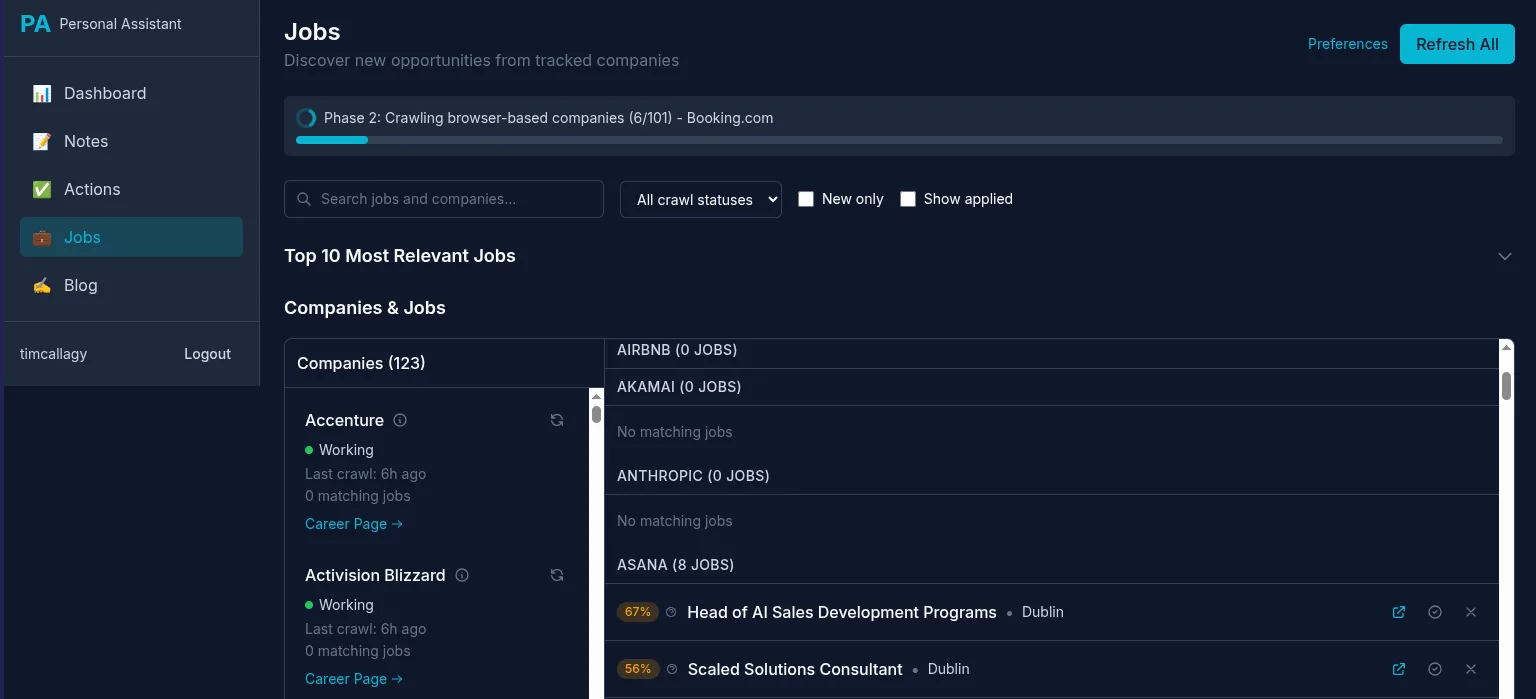
The top 10 scoring jobs are displayed on my Personal Assistant dashboard, and I have a dedicated jobs page where I can see jobs per company with their individual scores. For power use, everything is also exposed via MCP tools so I can manage companies, trigger checks, inspect listings, and update statuses directly from Claude CLI.
The numbers so far:
- 123 companies tracked (Dublin-focused tech)
- 3,673 jobs discovered
- 1,959 new jobs this week alone
The bigger point
This system has already surfaced jobs I wouldn't have previously seen, and some I wouldn't have previously considered but on closer inspection are actually pretty interesting.
But what makes this really interesting is not that it's better for me. It's that building bespoke software like this is now trivial compared to even a few years ago. When personalised tools can be created in days, broad vanilla platforms start to feel useless.
What happens when AI collapses workflows that used to require platforms, marketplaces, and intermediaries? LinkedIn's value historically was tied to aggregation, discovery, and filtering. Those are now solvable problems at the individual level.
This is just one small example, but I suspect it won't be the last.